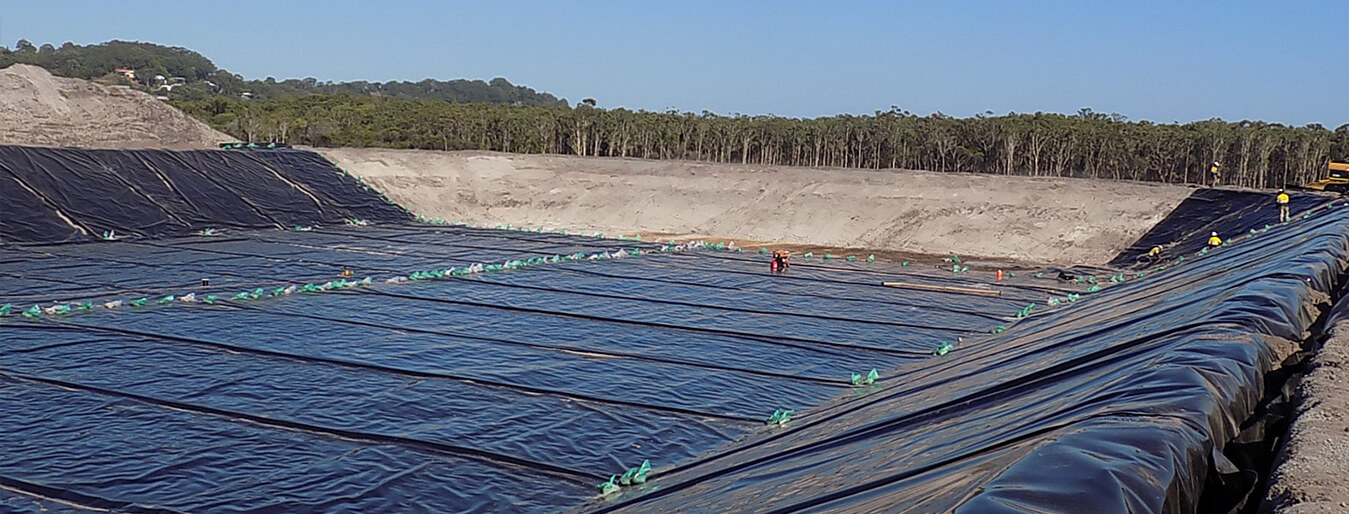
All dams lose water due to evaporation, which is expected when running a dam. However, if you observe rapid water loss even though the weather is dry and despite having had adequate rainfall, chances are that there is another cause for the problem.
High water loss could be due to several reasons: seepage, overly permeable soil, structural weakness, poor previous construction, or faulty/absent dam liner. This article will highlight the amount of evaporation that should be expected, possible causes of the excess water loss, ways to determine whether there is a problem and how to diagnose the issue yourself, and role of the dam liner in solving it.
Any exposed water surface will always experience evaporation – that’s just how physics works, no cause for concern here. The real question is, what’s the acceptable rate of evaporation in your case, for this dam, in your weather conditions?
The rates of evaporation increase in summer and decrease in winter. Any drop which may seem alarming in January is normal for the season.
A hot, dry, and windy weather pattern draws out much more water from a dam compared to cold, humid days. All three elements come into play, and a combination of a heatwave with wind may very well explain a sudden drop.
Water levels will vary depending on how much rain falls, how much water evaporates and the amounts used for domestic or agricultural needs. Some change is just normal behavior.
There are a few common causes that often turn out to be responsible when there’s trouble with the numbers.
Movement of water through the structure itself through to the ground around it, usually unseen from above.
Leakages in the actual wall of the dam, possibly due to its aging process but even from poor construction techniques when first built.
Movement of water through the dam through its foundation rather than through its walls.
Areas of the structure that were built in such a way as not to meet proper standards – weak areas, poor compaction and grading.
Dams that have never been properly compacted or built with an inadequate soil mix are usually fated for leakage no matter how well-maintained they become later.
If a dam liner has at some point been damaged, deteriorated or improperly installed in the first place, then this will almost certainly account for most of the problem.
Each of these needs examination on its own terms, as the solution varies accordingly.
Water retention by sandy soils in the way that happens in the case of clay soils is impossible due to the sizes of particles, which are large in the first case, and the soils are highly permeable.
Sometimes there may be soil that looks fine but has not enough clay to create a solid structure and withstand water.
Dry soil cracks, and cracks create a channel that water will move through once the reservoir gets filled again.
Tree roots can create gaps in the dam when growing or dead, leaving tunnels through the dams.
Dams settle over time, and therefore there appear gaps in places where initially there were no gaps at all.
Find typical evaporation rates in your area and for your season of the year and compare them to the levels of evaporation you are observing. If your water level is dropping significantly more than that, there is probably another reason.
Marking your water level and measuring it on a daily or a weekly basis will give you a much better idea than guessing from time to time.
Wet spots, lush or unusual vegetation around the walls of your dam or soggy soil nearby indicate a seepage problem.
Often, seepage appears on the downstream embankment first before showing up elsewhere, so a walk is recommended after the full dam especially.
A gradual decrease in water level that correlates with hot weather is normal. A sudden drop, however, is not.
It’s just math! Comparing how much rain goes in, how much you expect to evaporate, and how much water you take out for livestock or irrigation and figuring out what’s left. It’s one of the more reliable ways to determine if there is actually a problem.
Here’s a quick way to narrow down what you might be looking at:
| What You’re Seeing | Likely Cause | What it Suggests |
| Slow, steady drop, worse in summer | Normal Evaporation | Usually not a problem |
| Rain drop that doesn’t match the weather | Seepage or leak | Worth Investigating further |
| Wet Patches or lush grass below the wall | Dam wall or seepage leak | Needs closer inspection |
| Sudden overnight drop | Structural failure or burrow | Needs prompt attention |
| Consistent loss across every season | Soil permeability issue | May be worth considering a liner |
This is a general guide to help you narrow things down, not a diagnosis on its own — a proper site inspection is still the reliable way to confirm exactly what’s happening.
Clay is the preferred material for building dams since it combines well and has natural resistance to water flow.
Sandy ground is the opposite — it lets water through relatively easily no matter how well it’s compacted, which is often why sandy-soil dams struggle to hold water long-term.
Rock can create unpredictable seepage paths, since water finds its way through fractures and gaps rather than moving evenly.
A lot of dams sit on a mix of soil types across the site, which means seepage can be worse in one section than another — patchy, rather than uniform.
Soils that swell and shrink with moisture can crack open during dry spells and create new pathways for water loss each time the cycle repeats.
Dam A: Water levels dropped around 15cm a week through a hot summer stretch — which looked alarming at first. But running a proper water balance calculation showed only about a third of that drop matched expected evaporation for the conditions. The rest turned out to be seepage through a sandy patch on the dam floor that had never been dealt with.
Dam B: A neighbouring dam of a similar size, sitting through the same weather, showed a comparable seasonal drop — but this one lined up almost exactly with local evaporation estimates. No wet patches, no unusual growth downstream, nothing to chase up.
Same weather, similar dams, two very different explanations. It’s a good reminder that comparing your water loss to what evaporation should actually account for — rather than just watching the level drop and assuming the worst (or the best) — is what actually tells you what’s going on.
A “dam liner” is not a single item. There are several different types of liners which will depend on both the dam itself and the budget you have.
HDPE liners are best when you need something that is very durable and reliable, especially in the case of bigger dams and when water conservation is important.
If necessary, bentonite can be applied either as a lining material or added to the soil in order to increase its clay content and decrease its permeability – an inexpensive solution for smaller dams.
PVC liners are less expensive and easy to install compared to HDPE liners, but are less reliable and less durable in the long run, especially when exposed to sunlight.
Some areas may require the use of sprayed or composite lining systems which include a number of different materials combined into a layer.
It’s difficult to say that there is one universal solution – it all depends on your soil and dam size.
In case seepage is continually appearing regardless of any maintenance efforts taken, a liner may be the better solution.
Where sandy, rocky, or just plain difficult soil exists which doesn’t compact easily at all, this will be a sure sign that a liner will prove better than trying to make do with natural soil.
Water conservation is a serious problem in some areas, and therefore where every drop counts, a liner will be more justified.
Water stored for purposes of irrigation will need to be properly conserved since it is meant for the irrigation process.
In order to have a water supply for livestock, it will be necessary to ensure this through a liner.
In case the dam is intended to last for many years to come, a liner is the best solution.
The reason why a liner for a dam creates a barrier is that it physically separates the water from the soil beneath it rather than making the soil impermeable itself.
Because the barrier doesn’t work by increasing soil density, it will continue functioning regardless of the soil being leaky.
A good quality dam liner can perform equally well on sand, clay or mixed soils – an advantage that soil alone cannot offer.
A liner for a dam makes seepage minimal, and thus increases water storage capacity in the dam over time, unlike soil that slowly loses efficiency.
A well installed dam liner when maintained properly has a service life of many years – much longer than expected by farmers.
Dam liners used in open dams are constantly subject to external factors such as heat, UV and frost. This has to be taken into consideration when choosing materials and installing a liner.
Cracks that may occur in the wall itself, due to either drying or settlement processes, result in direct conduits through which water could escape.
A badly designed or degraded spillway could end up leaking water that isn’t even seepage in any way.
Areas of the dam which were not compacted correctly during construction remain weak spots for many years.
Roots and thick vegetation that grow into the dam embankment slowly create cracks.
It’s not only burrowing animals that cause trouble; other large animals accessing the dam will erode its banks.
Changes in the groundwater of the area will affect the movement of water through the dam in unseen ways.
Proper vegetation control around the dam is necessary to ensure that there is no root damage to the dam and to facilitate problem detection.
Uncontrolled access by livestock may cause erosion on the banks and disturb the dam floor; thus, drinking access by stock needs management.
Inspection involves walking around the structure from time to time to detect small defects such as cracks, wet areas, and entrance of burrows.
Sediment accumulation may interfere with storage capacity and effectiveness of the liner/soil barrier.
Erosion prevention and minimization of heavy truck traffic are just some examples of methods for embankment protection.
The hooves of livestock could eventually destroy the liner because of unrestricted access to the soft ground near the shores.
The farmer would put up a fence around the area that is lined and have a defined drinking point for the livestock.
In situations where access is required, an appropriately constructed access point will allow the livestock and wildlife to drink without constantly stepping on the liner.
Livestock are not the only things that could puncture the liner.
Walkover survey of the dam site, including an inspection of the embankments, the wall and any signs of seepage.
Soil survey in order to establish how permeable the soil is and what percentage of the soil is clay, as this will be important in understanding whether the problem is coming from the soil itself.
Structural survey of the walls, to check for any evidence of cracking, erosion and/or settlement.
Depending on the situation, water balance calculations, visual tracer method, or specialized leak detection equipment may be used.
If there is a dam liner present, assessing whether it is punctured, lifted or has otherwise degraded is an essential part of the process.
Based on the results of all the surveys above, a decision will be made on whether the repair will involve maintenance or repair/relining.
Large dams that exceed a minimum capacity may be regulated by dam safety regulations that impact what work can be done and how it is done.
Based on the area in which you operate, the conditions of your water license may include considerations relating to dam capacity, usage, or alteration.
Catchment authorities may require consent prior to undertaking projects such as relining, especially if the dam exceeds a certain capacity.
It’s always worthwhile checking with your local catchment authority before embarking on any major project – it’s better to know up front rather than halfway through.
Yes – there are numerous cases where dams that did not have any lining to start with eventually get retrofitted with a lining due to persistent seepage problems.
Generally speaking, the dam has to be drained (at least in part), and its base cleared from debris and properly prepared before installing the lining.
There is an array of obstacles connected with installation of a lining, including existing structures, inlets and outlets, and uneven terrain. This process is a little more complex than installing a lining in a new structure.
One way of reducing the interference of the process on the operation of the dam is choosing the dry season for the installation.
This work typically begins with lowering the water level to as low as possible, sometimes completely draining the dam based on the work at hand.
All sharp materials and any debris that might scratch the membrane lining are cleared out, and the bottom is made level.
The liner is laid out to cover the necessary area with seams connecting the pieces as required.
The edges of the membrane are secured, commonly in a trench surrounding the entire structure.
Once all is said and done, the dam is filled, and it is ready to be put back into use again.
This will give you an idea of how this work will go and how long you will have your dam out of commission, but you should discuss this directly with the contractor since this will depend on your specific situation.
There’s no single figure that applies to every dam. Cost depends heavily on the size of the dam, the liner material chosen, how much site preparation is needed, and how easy the site is to access with equipment.
Timeframes vary just as much. Smaller dams with straightforward access can often be relined in a matter of days. Larger dams, or ones needing significant preparation work first, can take considerably longer. As with most things in this article, addressing seepage early — before it gets worse — tends to keep both the scope and the cost of the job smaller than waiting it out.
Any sediment collected at the bottom of the lined base may affect its capacity and should be removed from time to time.
Keeping unrestricted stock access and heavy machinery away from the liner reduces the risk of accidental punctures.
A small puncture caught early is a quick fix. Left alone, it can grow into a much bigger repair job.
Installing a liner isn’t really a “set and forget” job — a bit of routine care goes a long way toward getting the full service life out of it.
It’s worth getting expert eyes on your dam when:
A professional assessment will confirm what’s actually causing the loss, and a dam liner may come up as one possible long-term solution depending on what they find.
Worth having answers to before committing to a project:
Evaporation is a normal, expected part of every farm dam’s water cycle — but when water levels keep dropping faster than the weather can explain, it’s usually a sign of seepage, soil permeability, a structural issue, or a problem with an existing liner. Learning to tell normal evaporation apart from abnormal water loss is really the first step toward protecting a resource that most farms can’t afford to lose. This is where experienced professionals like GDT Lining come into the picture.
Where seepage keeps coming back no matter what maintenance is tried, a properly designed dam liner — matched to your dam’s soil conditions, size and intended use — can offer a genuinely long-term fix, cutting water loss and giving you a more dependable water supply for years to come. As with any major work on farm water infrastructure, it’s worth checking local approval requirements and asking the right questions of an installer before getting started.
Copy Right 2018
Powered By : Onqanet technologies